

An End Fed Half-Wave antenna is a type of radio antenna that has it’s feeding point at one end rather than at the center.
Key Features:
-
- Simplicity: EndFed antennas are relatively simple to construct and install, making them ideal for amateur radio operators with limited space.
- Versatility: They can operate on multiple bands when paired with an appropriate matching device, often making them a popular choice among HF (High Frequency) operators.
- Space Efficiency: Because they don’t require a significant amount of real estate to set up, they are suitable for small properties or urban environments.
Working Principle:
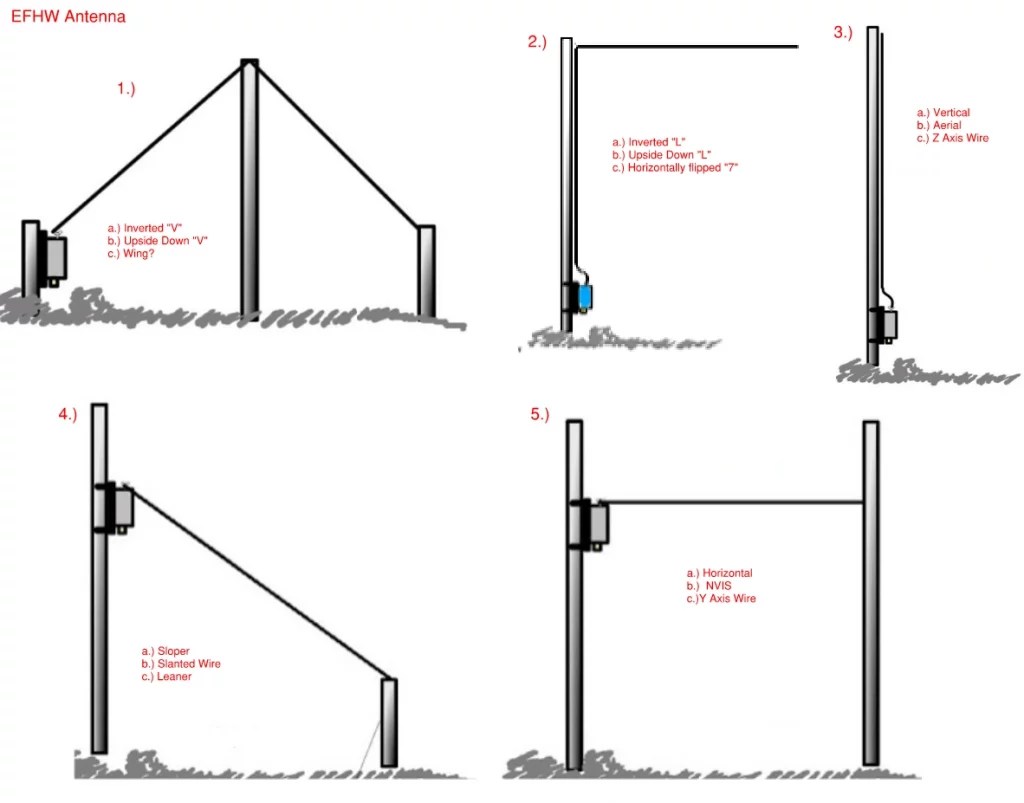 The end-fed design allows it to efficiently radiate or receive radio waves despite being fed at one end. They can be configured as half-wave or multi-band antennas, depending on the length and setup.
Since a half wave antenna has a high impedance at the feed point (around 5000 Ohm), an End Fed Half-Wave (EFHW) is typically connected with a 1:49 matching transformer at feed point. This matching transformer transforms the high impedance of the end fed half-wave (about 2500 Ohm) to around 50 Ohm.
Mythes:
-
- Inefficient: due to it’s relative short length, an End Fed is inefficient.
- Picking up a lot of QRN/QRM because it’s an a-symmetrical wire antenna.
- Generating a lot of RFI (Radio Frequency Interference) because their fed at the end of the wire.
Inefficient
Because an End Fed is often (not always) a multi-band antenna (usable for multiple amateur bands) it’s quite long for the higher bands and short for the lower bands. Of course there is always a compromise. For the lower bands (80m) it’s efficiency is lower indeed, depending on the wire length you use. But at least you have a working antenna for these bands! Generally the efficiency of the End Fed Half-Wave is pretty high on 10, 15, 20 and 40m.
QRN/QRM sensitive
In theory its correct to state that end fed antennas are more sensitive to pick up static and man made noise (QRM). But that’s theory. Practically you will see it depends much more on circumstances where the antenna hangs then on the antenna itself. For instance: hangs the wire freely and is there enough height from the ground? Also it is important to create some kind of HF-earth. Generally if you take care of these things, a End Fed Half-Wave is not more sensitive to QRN/QRM.
Generating RFI
The main thing of causing RFI for almost every antenna is common mode. When the antenna is able to use your feedline as part of the antenna is were common mode arises. There are possibilities to avoid common mode. On is to use a good common mode choke in your coax cable. There are reports of amateurs who state you should use a common mode choke to close to the feed point of an End Fed Half-Wave. In my case I put a common mode choke directly under the 1:49 transformer and it works great. No RFI in the shack or other RFI-related issues.
Conclusion
So you can see that most negative myths are coming from experiences where operators didn’t understand the real cause of the problem. But that has little or nothing to do with the End Fed Half-Wave antennas design or working.
Overall, EndFed antennas provide a practical solution for operators looking for an effective antenna for multiple bands without complex installations.
Do you have experience with these antennas? Please leave a comment!
Links:
Nice how to to build an End Fed Half-Wave.
A deep dive into the theory of the End Fed Half-Wave.
A good video explanation of W2PAK on an End Fed Half-Wave.
Excellent information on the Half wave End Fed Antena
excellent information on feeding the End Fed Vertical also built two of the 23mc transceivers
and attempting the 23 cm data transceiver but having problems finding the coils so decided to wind my own I think they are for 54 Mhz as there is no data on them in the instructions